|
M
A S I
M A N A G E R I A L R A T I O S
by
H A N S J E S S E N
The Technical University
of Denmark
November 1982
AMT Publication
DI.82.85-A
.
ABSTRACT
In order to determine
managerial ratios as mathematical analytical functions of time there has
been developed a graphical model of a firm. This model shows the physical relationship
between fundamental principles of bookkee- ping, operating statements and
managerial economics. The model is the structural basis of the
determination of the mathematical analytical functions for management.
The analytical
background of traditional ratio techniqu- es, including, Bela Gold lit. 40
and the Dupont pyramid, is described by means of a new developed general
manage-rial ratio funktion.
.
- I -
CONTENTS
Page
Sumary V
Preface VI
Part A:
CHAPTER A
1. An analytical business model 1
1.1. Introduction 1
1.1.1. S. Eilon's model 1
1.1.1.1. Functional relationships and assumptions 3
1.1.1.1.1. Change in the cost structure 7
1.1.1.1.2. Change in the earnings structure 13
1.1.2. Assessment of S. Eilon's
model
18
Part B:
CHAPTER_B
2. An analytical graphical business model 20
2.1. Activity parameters 20
2.1.1. Sales
20
2.1.2. Purchases
20
2.1.3. Inventories 22
2.2. Payment parameters, operations
2.2.1. Sales
22
2.2.2. Purchases
23
2.3. Market parameters, sales 23
2.3.1. Cash sales ratio q 23
2.3.2.
The price p 24
2.3.3. Debit time dD 24
2.4. Market parameters, purchases 25
2.4.l. Cash purchases ratio
e 25
2.4.2. The price q1 of raw materials 26
2.4.3.
The price q2
of labor hours 26
2.4.4 Credit time dK 27
- II -
3.1. Income statement 28
3.1.1.
Sales of goods 28
3.1.2.
Costs 29
3.1.2.1.
Inventories, additions (with signs) 30
3.1.3. Resource consumption (incl. F'i,1) 33
3.1.4.
Operating profit (before interest and deprec.) 33
3.1.5.
Operating profit incl. inventory deprec. 33
4.1. Chanqe in liquidity (operations) 35
5.1. Cash balance 36
5.2. Bank loans 36
5.3. Loans (long-term)
37
6.1. Investment (in fixed capital)
38
7.1. Depreciation (for tax purposes) 39
8.1. Interest (for tax purposes)
40
9.1. Tax pavments 4O
10.1. Principal ratios 41
10.1.1.
Operating profit 0'(t) 41
10.1.2.
Change in liquidity l'(t) 42
10.1.3.
Working capital K(t)
43
10.1.4. Contribution ratio DG(t) 43
10.1.5.
Depreciation 44
10.1.6. Interest r'BL(t) 44
.
- III -
CHAPTER C
11. An analytical mathematical businessmodel 45
11.1. Physical and financial functions i
the operating
system
45
11.1.1. Sales
45
11.1.2. Inventories 46
11.1.3. Output
50
l1.1.4. Sales, ingoing payments 50
11.1.5. Purchases, outgoing payments
51
11.1.6. Change in liquidity 52
11.2. Capital tied up in the operating
system 52
11.2.1. Trade accounts receivable 52
11.2.2. Trade accounts payable 53
11.2.3. Raw materials invefitory 53
11.2.4. Finished goods inventory 54
11.2.5. Working capital (tied up in the operating system
54
12.1. Operatinq profit (for accountinq purposes) 55
12.2. Operating profit (computed on the
basis of Fig. 2.1.) 56
12.2.1. Operating profit incl. inventory depreciation
58
12.3.1. Bank loans
59
12.3.2. Loans (long term) 60
12.3.3.
Investments 60
12.4.1. Interest payments 61
12.4.2. Depreciation 61
12.4.3. Tax payments 61
12.4.4. Cash flow released 62
12.4.4.1.
Interest relative 63
12.4.4.2.
Depreciation relative 63
.
- IV -
13.1. Traditional ratios 64
13.1.1 Contribution ratio 64
13.1.2. Profit ratio 64
13.1.3. Break-even sales 64
13.1.4. Margin of safety 65
13.1.5. Applications, examples 65
13.2. Dupont pyramid 66
13.2.1 Ratio mathematics, general
68
CONCLUSION 7O
BIBLIOGRAPHY 72
.
- V -
SUMMARY
For the determination of ratios as
analytical mathematical functions of time a graphical model of a firm has been
developed. This model is a graphical representation of the relationships
between fundamental aspects of the firm relating to book-keeping (records),
accounting and managerial economics. The model forms the basis of the
following deve- lopment of analytical mathematical functions. The
mathematical back-ground of traditional ratio techniques, including Bela
Gold lit. 40 and the Dupont pyramid, is shown through the development of a
general ratio function.
Lyngby, November 1982
.
- VI -
PREFACE
The existing literature on accountancy
and managerial economics has ma- de several attempts to improve the
theoretical basis in order to provide management with a better
understanding of business management possibili- ties.
In lit. 20, Albert Danielsson is dealing
solely with purely analytical
aspects in relation to costs of
production, and he has in that connec- tion developed symbolic flow charts
for analysis purposes. This work seems to be of a very special character and
not suited for overall ma- nagement purposes where the firm is to be seen
as a whole. Links to inventories and the market are, for instance, missing.
Bela Gold, lit. 40, attempts to
generalise accounting ratios in a tech-nical structure which includes
managerial ratios. This technique seems to be very practicable but only for
partial global business analyses. In this thesis a theoretical analysis of
general ratios will be made, in-cluding the Dupont pyramid and including,
in particular, Bela Gold's ratio technique.
J. W. Forrester, lit. 37, provides with
his special representation
technique based on computer technology an
excellent basis for analy- sing company behavlour. It gives, in a certain
degree, a good insight into the behavlour of a firm in situations with
different external and internal influences. Also here a fundamental
mathematical model for purely analytical purposes is missing.
Dan Ahlmark, lit. 1, stresses the
necessity of developing an analysis
model of the business which makes it
possible to consider the current
integrated process, production,
investment, financing activities of the business. To illustrate this need,
an extensive empirical business ana- lysis is made, using generally known
simulation techniques.
.
- VII -
Finn C. Sørensen, lit. 97, finds in his
review of traditional accoun-
ting methods that a model should be
developed for man agement which is
suitable for illustrating general matters
in the firm, i.e. form the
basis of an actual managerial audit. By this
is meant an examination of activities and matters underlying the
financial/accounting report.
Samuel Eilon, lit. 30, attempts with his
mathematical model to compute
the rate of return as a function of
general business parameters, using, among other things, a symbolic
graphical representation technique to de-scribe the inter relationships of
the equations. This work seems to be the most interesting work in the
literature seen in relation to the de- velopment of a generalised business
analysis model.
Using the literature reviewed as a
starting point with special impor-
tance being attached to the above
authors, the structure and field of
applications of Eilon's model in lit. 30
will be analysed in detail.
After this analysis, a graphical
analytical business model is developed in Chapter B including book keeping,
accounting and financial concepts to be employed by the business
management. Using this model it is possi-ble to carry out an actual
managerial audit as described by Finn C. Sø- rensen, among others.
Chapter C defines an analytical
mathematical business model based on the general graphical structure shown
in Chapter B. As a special starting point is taken the fact that any sales
curve may be composed of a piece- wise linear function. The basic element
of the sales function is thus chosen as a linear function of time.
Based on the developed mathematical
functions the most common accounting ratios are computed as a function of
time.
.
- VIII -
Bela Gold's ratio technique is examined
more ciosely, using general ma-thematical ratio functions developed in this
report, and an attempt is made to explain it by means of these functions,
which are also used to illustrate
the technical background of the computation of the rate of return in the
Dupont pyramid.
.
C
H A P T E R A
.
- 1 -
1.
An analytical business model
1.1.
Introduction
During the mentioned review of the
litterature only one source was found, which was suitable for forming the
basis of the development of
the general mathematical business model
in Chapters B and C. This sour- ce was Samuel Eilon's article in OMEGA
1997, Vol. 5, No. 6: "A Profita- bility Model for Tactical
Planning", lit. 30.
In the following the mentioned article
will therefore be discussed as
an introduction to the analytical
mathematical business model in Chap-
ter C.
1.1.1
S. Eilon's model
The article starts by pointing out that
simple models reflecting aggre- gate company behaviour in response to
changes imposed by management de- cisions and/or outside factors provide
useful tools for management for tactical planning purposes.
As his starting point, Eilon takes the
rate of return r expressed as:
(p - c)V
r = ¾¾¾¾¾
(1)
I
or
earnings
r =
¾¾¾¾¾¾¾¾¾¾¾ (2)
total investment
where
.
- 2 -
p = unit price per unit of output
c = unit cost per unit of output
V = output units per time unit
I = total investment
Attention is drawn to the fact that for
macro economic purposes it is
possible to compute the ratio r from the
definition equation (2) and
thus obtain information on an industry's
"profitability".
Equation (1) is a micro economic
rewriting of (2) based on "logical"
considerations. The numerator in equation
(1) is fairly well defined,
also in a micro economic model, but the
denominator I, total assets,
which serves the main purpose, is
difficult to determine in practice.
Additions to and disposals of assets as
well as changes in the market
value of these assets take place currently.
The practical purpose of the computation
of the rate of return is a
desire to obtain an equivalent measure of
the return on investment. It
appears from the above that in practice
the com putation of r involves
great uncertainty so that r is a relatively
uncertain measure of profi- tability. If the following definitions are now
introduced
dp dc dI
p* = ¾¾¾ ;
c*
= ¾¾¾ ; I* = ¾¾¾ ,
p d I
where the changes dp, dc, dV and dI are
given, equation (1) can be
transformed into
1 1 + V*
r* = ¾¾¾¾¾¾ (¾¾¾¾¾ (p* - (1 - a) c*) + V* - I*) (3)
1 + I* a
.
- 3 -
p - c
given definition a = ¾¾¾¾¾ = the relative
profit margin.
p
As regards equation (3), S. Eilon
observes that it is an analytical tool for assessing the effects on r of
changes of the variables of the
right hand side.
In practice, a functional inter
relationship exists very often between
these variables; a later change in the
selling price or the cost price will, for instance, bring about changes not
only in investments (in
the working capital) but also in demand
and hence output.
1.1.1.1.
Functional relationships and assumptions
Eilon assigns to the cost c per output
unit the following conventional
functional expression:
F J
c = s + ¾¾ + ¾¾ (4)
V V
where
s represents direct
unit costs
F
¾¾ represents indiret unit costs excl. interest
V
J
¾¾ represents interest
charge per unit.
V
Equation (4) is a so called traditional
economic calculation of total
unit costs. It should, however, be noted
that from a general accoun-
ting point of view there is no real
justification for equation (4). It
is simply an appropriate formula for the
unit cost function in relati-
on to the traditional theory of
managerial economics, which makes it
possible to carry out simple partial
operations research computations
.
- 4 -
concerning, for instance, profit
maximization in relation to various
alter natives.
The stressing of the point that equation
(4) has no real physical ju-
stification is due to the fact that
equation (4) is a simple transfor- mation of equations (5) and (6).
TO = c V (5)
TO = s V + F + J (6)
Equation (5) is here a purely non
physical definition equation (addi-
tion of simple "krone amounts")
for the total costs TO specified via
the definition equation (6). It will be
seen that these definition equa- tions give rise to problems in connection
with the physical interpreta- tion. What is, for instance, meant by fixed
costs, and how are they de- fned in relation to, say, the interest charges
J ?
A transformation of equation (4) using
the definitions s = f1 c , F/V
= f2 c and J/V = f3 c gives
1
c* = f1 s* + ¾¾¾¾¾(f2 F* + f3 J* - (1 - f1) V*) (7)
1 + V*
This equation (7) shows that with a good
approximation we have:
c* = f1 s* + f2 F* + f3 J* - (1 - f1) V* (8)
Interpretation of the contents of, for
example, (8) will show that the
percentage change of the unit costs is
equal to the weighted sum of the percentage change of s, F, J and V.
.
- 5 -
Concerning investments I, S. Eilon
assumes:
IW = A + B (9)
I = IW + IF (10)
where
IW = the working capital
IF = investment in fixed assets
B
= bank loans + overdrafts
A
= other loans
S. Eilon also defines:
w = IW/I (10a)
l = B/IW (10b)
J = j B , where j is the interest rate (lOc)
Equation (10) can now be transformed
into:
I* = w I*W + (1 - w)I*F
(11)
Equation (9) can be transformed into:
I*W = (1 - l) A* + l B* (12)
A combination of equation (12) and
equation (11) will take the form:
I* = w ((1 - l) A* + l B*) + (1 - w) I*F (13)
For use in the actual planning process of
the business, S. Eilon assu-
mes that
.
- 6 -
I*F = 0 (14)
and
A* = 0
(15)
It is also assumed that w and l are constant (the artiticle does not
mention this explicitly).
Based on the mentioned assumptions
equations (12) and (13) are then
reduced to
I*W = l B* (16)
and
I* = w l B* (17)
gives the conditions (14) and (15).
In connection with the determination of
changes in the working capital
IW, S. Eilon writes:
"No single relationship between
working capital and the 1evel of ac-
tivity in the firm is universally
accepted and we may proceed to ex-
plore two possible assumptions."
These two assumptions are combined as a
linear combination
I*W = g (p v)* + h(c V)* (18)
which denotes that the working capital
(tied up in the operating sy-
stem is changed as a linear combination
of the change in sales and the
change in cost. S. Eilon claims that no
controller has difficulty in
determining empirically the constants g
and h. It must therefore be
.
- 7 -
possible to find a physical model which
describes these empirical facts. A mathematical analytical solution to this
problem is described
in Chapter C.
S. Eilon proceeds to consider three cases
which are relevant for tac-
tical planning purposes:
1. Change of s, F and j
2. Change of V
3. Change of p
In the first case changes in the cost
structure are considered. The
following two cases deal with changes in
sales and changes in the mar-
ket price, i.e. two situations where the
earnings structure is chan-
ged. However, as regards cases 2 and 3, it
is natural to describe them
together as will be seen later. The
things to be discussed are therefo- re as follows:
1. Change in the cost structure caused by
changes in s, F and j.
2. Change in the earnings structure
caused by changes in V given the
market elasticity e.
1.1.1.1.1. Change in the cost structure
Attention is drawn to the fact that in
his case 1 S. Eilon discusses
an iterative process, physical and
mathematical, in connection with the final computation of c*. From a physical point of view,
this is in full accordance with the accounting theory, as will be shown
later in the ge- neral mathematical business model. S. Eilon attempts to
provide this "fact" of the expressions de scribed here through the mathematical convergence in the computation
of total unit costs as shown in the article. In this respect, however, it
does not seem to be a good idea to combine physical and mathematical facts
too much since, as has already been
- 8 -
mentioned, S. Eilon employs a non physical
definition of unit costs (see equation (4), which highly weakens the
foundation of Eilon's conclusi- ons.
S. Eilon elaborates on this definiton of
the unit cost, one of the prin- ciples of traditional theories of
managerial economics, in case 1. It is exactly these conflicts between the
physical conditions in the firm and the traditional theory of managerial
economics which have caused the de- velopment of the mathematical business
model described in Chapter C.
With a view to solving the existing
mathematical problem, equation
(1Oc) is transformed into:
J* = j* + (1 + j*) B* (2o)
The mathematical problem can now be
solved by means of the followinq
previously shown equations (7), (16) and
(18) together with the reated conditions:
Equations:
1
c* = f1 s* + ¾¾¾¾ (f2 F* + f3 J* - (1 - f1) V*) (21)
1 + V*
J* = j* + (1 + j*) B*
(22)
I*W = l B* (23)
I*W = g(p v)* + h(c v)* (24)
.
- 9 -
given the conditions
V* = 0
(25)
p* = 0 (26)
A solution is obtained as follows:
From equation (24) with the conditions
(25) and (26) it follows that
I*W = h c* (27)
Equation (27) and (23) give
h
B* = ¾¾
c* (28)
l
A combination of equation (28) and (22)
gives
h
J* = j* + (1 + j*) ¾¾ c* (29)
l
A combination of equation (29) and (21)
gives
f1
s* + f2 F* + f3 j*
c* = ¾¾¾¾¾¾¾¾¾¾¾¾¾¾ (30)
h
1 - (1 + j*) ¾¾ f3
l
In equation (30) the question is raised whether
h
(1 + j*) ¾¾ f3 < 1
l
has been satisfied as, in practice,
equation (lOb) shows that
1 IW
¾¾ = ¾¾
l B
.
- l0 -
Normally will IW < B, hence
1
¾¾ < 1
l
As typically in practice h < 1, f3 < 0.5 and (1 + j*) < 1.5, inequa1ity
(31) gives
h 1
(1 + j*) ¾¾ f3 < 1,2 ¾¾ 0.5
l 1
or
h
(1 + j*) ¾¾ f3 < 0.6
l
From this will be seen that, in practice,
inequality (31) has been sa-
tisfied.
S. Eilon introduces a new ratio H = IW /(c V) for the purpose
showing
that inequality (31) has been satisfied
in practice. This seems to be
a purely mathematical exercise without
any relevant justification phy-
sically. It is once more pointed out that
S. Eilon overinterprets the
mathematical consequences of the use of
the equation (4) defined on the basis of managerial economics.
For the purpose of computing the rate of
return the equations (3),
(lOa) and (18) are used to solve the
equations:
1 1 + V*
r* = ¾¾¾¾¾ (¾¾¾¾¾(p* - (1 - a) c*) + V* - I*) (32)
1 + I* a
1
I =
¾¾ IW (33)
w
.
- 11 -
I*W = g(p V)* + h(c v)* (34)
with the conditions:
f1
s* + f2 F* + f3 j*
c* = ¾¾¾¾¾¾¾¾¾¾¾¾¾¾ (35)
h
1 - (1 + j*) ¾¾ f3
l
V* = 0 (36)
p* = 0
(37)
Equation (34) gives, cf. equation (27)
I*W = h c* (38)
Equation (33) is transformed into
I* = w I*W (39)
Equatioin (38) combined with equation
(39) gives
I* = w h c* (40)
Equation (32) gives with equation (40)
and the conditions (35),
(36) and (37) the following expression
c*
1 - a
r* = - ¾¾¾¾¾¾¾¾ (¾¾¾¾¾ h w ) (41)
1 + w h c* a
given
f1
s* + f2 F* + f3 j*
c* = ¾¾¾¾¾¾¾¾¾¾¾¾¾¾ (30)
h
1 - (1 + j*) ¾¾ f3
l
.
- 12 -
As regards equation (30) it should be
noted that S. Eilon finds it
"justified" to define a
quantity
c*0 = f1 s* + f2 F* + f3 j* (42)
as unit costs, if h = 0, i.e. if no
changes occur in the working ca-
pital with the given conditions V* = O and p* = 0 , cf. equa tion (38).
Equation (35) now takes the form
c*0
c* = ¾¾¾¾¾¾¾¾¾¾¾¾¾¾ (30)
h
1 - (1 + j*) ¾¾ f3
l
given
c*0 = f1 s* + f2 F* + f3 j*
Further, on the basis of the denominator
in equation (43), S. Eilon
defines a ratio u as he seems to find it desirabie
that all ratios oc-
cur in product form. For instance, as
mentioned previously in this
connection, he also defines the ratio H =
IW/(c V), which from the
point of view of accounting theory is a
very specific concept.
A look at equation (43) will show that it
takes the form of "ratios",
i.e. it contains dimensionless
quantities, which are all ratios in the
firm. Therefore, it does not seem to be a
very desirable measure to
introduce further ratios to give the equa tion a changed algebraic
structure.
However, for analytical purposes in
connection with an analysis of the
numerical "behaviour" of
equation (43) it may be useful to define a
parameter x given by
.
- 13 -
h
x =
(1 + j*) ¾¾ f3 (44)
l
so that equation (43) is transformed into
c*0
c* = ¾¾¾¾¾ (45)
1 - x
given
h
x =
(1 + j*) ¾¾ f3 (46)
l
and
c*0 = f1 s* + f2 F* + f3 j* (47)
Thus, by a preliminary nurnerical
analysis of (45), x may be a11owed
to vary in the interval 0 < x < 1.
It should be noted that x is here a
parameter. In the second phase of such an
anal ysis a numerical ana- lysis of
equation (46) can be carried out, given certain selected va- lues of x.
1.1.2.1.2. Change in the earnings structure
In this case where management wishes to
consider the influence of the
market on the rate of return, etc., the
following expression is assu-
med to apply
V* = - e p* (48)
given p*.
.
- 14 -
The problem is thus given by the
equations
1
c* = f1 s* + ¾¾¾¾¾ (f2 F* + f3 J* - (1 - f1) V*) (49)
1 + V*
J* = j* + (1 + j*) l B*
(50)
I*W = l B* (51)
I* = g(p V)* + h(c V)*
(52)
with the conditions:
s* = 0
(53)
F* = 0
(54)
j* = 0 (55)
V* = - e p* (56)
Here equation (52) is transformed into
I*W = (g + h)V* + (g p* + h c*)(1 + V*) (56a)
After the transformation of the above
equations and with the above
conditions the following equations are
developed:
1
c* = ¾¾¾¾¾ (f3 B* - (1 - f1) V*) (57)
1 + V*
1
B* =
¾¾((g + h) V* + (g p* + h c*)(1 + V*)) (58)
l
given the condition V* = - e p* (59)
.
- 15 -
Now equations (57), (58) and (59) give by
simple reduction
e
p*
1 f3
c* = (1 - f1) ¾¾¾¾¾ ¾¾¾¾¾¾¾¾¾¾ (1 - ¾¾¾¾¾¾¾
1 - e
p* f3 (1 - f1) l
1 - ¾¾¾ h
l
(h + g(1 + p* - e-1))) (60)
given the conditions
s* = 0
(61)
F* = 0
(62)
j* = 0 (63)
V* = - e p* (64)
In connection with the practical use of
equation (60) it might be de-
sirable to define a change in the unit
cost cx* given by
e
p*
c*x = (1 - f1) ¾¾¾¾¾¾ (65)
1 - e
p*
which has been obtained by putting s* = 0, F* = 0 and J* = 0 in equati- on (7). c*x can here be interpreted as the
change in the unit cost if the only thing to be considered is a change in
the price p.
Moreover, from equation (60) can be
defined
g
y = ¾¾¾
h
which may be interpreted as the need of
investment in the working ca-
pital caused by sales in relation to
caused by costs (see equation (18)).
.
- 16 -
The system of equations (60) .... (64) is
now given the form
c*x x
c* = ¾¾¾¾ (1 - ¾¾¾¾ (1 + y(1
+ p* - e-1))) (66)
1 - x 1 - f1
given the conditions
h
x =
(1 + j*) ¾¾ f3 (67)
l
g
y = ¾¾¾
h
Using equations (3), (17), (57) and (60)
.... (64) the following sy -
stem of equations can now be defined for
the determination of the rate
of return.
Equation:
1 1 -
e p*
r* = ¾¾¾¾¾¾¾ (¾¾¾¾¾¾ (p* - (1 - a) c*) - e p* - w I*W) (69)
1 + w I*W a
given the conditions
s* = 0 (70)
F* = 0
(71)
j* = 0
(72)
V* = - e p* (73)
I*W = (g + h)V* + (g p* + h c*)(1 + V*) (74)
e
p* 1 f3
c* = (1 - f1) ¾¾¾¾¾ ¾¾¾¾¾¾¾¾¾¾ (1 - ¾¾¾¾¾¾¾
1 - e
p* f3 (1 - f1) l
1 - ¾¾¾ h
l
(h + g(1 + p* - e-1))) (75)
.
- 17 -
If changes are recorded only in V, the
following system of equations
is obtained by replacing p* with V* and putting p* = 0 and e-1 = 0 in
the above equations:
V* 1 f3
c* = - (1 - f1) ¾¾¾¾¾ ¾¾¾¾¾¾¾¾¾¾ (1 - ¾¾¾¾¾¾¾
1 - V* f3 (1 - f1) l
1 - ¾¾¾ h
l
(h + g)) (76)
given the conditions
s* = 0
(77)
F* = 0
(78)
j* = 0 (79)
e-1 = 0
(80)
p* = 0
(81)
and the system of equations:
1 1 - a
r* = ¾¾¾¾¾¾¾ (V* - ¾¾¾¾¾ (1 + V*) c* + w I*W) (82)
1 + w I*W a
given the conditions
s* = 0
(83)
F* = 0 (84)
j* = 0
(85)
I*W = (g + h(1 + c*)) V* + h c* (86)
V* 1 f3
c* = - (1 - f1) ¾¾¾¾¾ ¾¾¾¾¾¾¾¾¾¾ (1 - ¾¾¾¾¾¾¾
1 - V* f3 (1 - f1) l
1 - ¾¾¾ h
l
(h + g)) (87)
Attention is called to the fact that the
resuits in this Chapter dif-
fer from S. Eilon's results in cases 2
and 3. The following Chapter
will indude a general discussion of S.
Eilon's results and models in
the light of the results achieved here.
- 18 -
1.1.2. Assesment of S. Eilon's model
It has already been pointed out that the
basis of S. Eilon's model gi- ves rise to the question as to whether it
serves any purpose to carry out these computations and at the same time
attach such fundamental importance to the models shown in the article in
relation to the phy- sical business situation.
Thus, S. Eilon assumes that eguation
(4) is fundamental, i.e. a funda- mental starting point for
considerations based on managerial economies. With reference to eguations
(5) and (6) it was stated that this is a point of view which should be
examined more closely. This examination leads to the point that eguation
(4) is a purely mathematical definition equation, i.e. an equation which
is not founded on real physical facts (equation (6)'s right hand side
consists of a sum of elements of widely differing physical origin with only
one thing in
common: the value "DKK").
Owing to the mathematical structure of
equation (4) it will mathema-
d J(V)
tically be convergent as where U £ ¾¾¾ (¾¾¾)
£ K , in practice U
dV V
and K are constants. The physical
convergence also exists in connec- tion with the changes in the tactical
planning process (transients) under consideration. It should be noted that
the mathematical model shows the relationships between changes in
states" (i.e. time is not included explicitly) with the related
mathematical characteristics of the manner of converging. The physical
activity/cash flow model of the business is knovn also in practice to
possess convergent characteri- stics as a function of time. See chapter C.
Against this background it is important
not to attach too great impor-
tance here to the applicability of S.
Eilon's model to an interpreta-
tion of the dynamics of the firm (for
tactical planning purposes).
Thus, the mathematical business model,
Chapter C, is not to take state
functions as its starting point but only
use a time description of the
functions.
.
- 19 -
The graphical description used by S.
Eilon can only be regarded as a
dear description of the equations between
the individual variable.
being studied.
In Chapter B a physical model description
of the business will the-
refore be given first, the greatest
importance being attached to ma-
king the physical/financial description
as realistic as possible. Af-
ter this the mathematical déscription is
developed in Chapter C.
The results achieved in the present
Chapter A differ from S. Eilon's
results as far as computations of the
effects of changes in the ear-
nings structure are concerned. It is
pointed out that S. Eilon's un-
structuralized consideration of the
mathematical methods of solution
may be the reason for the deviating
results in the article.
The central equation (18), which
estimates the relationship between the working capital tied up in the
operating system, will be analysed in detail in Chapter C.
.
C H A P T E R
B
.
- 20 -
2.
An analytical graphical business model
This Chapter describes an analytical
graphical business model (see Fig. 2.1.). This model will form the basis of
a mathematical analytical description of the business so that this
description can be used by the business management for their principal
planning activities. The model will integrate principal elements of
managerial economics and the ac- counting theory, it being assumed that the
business comprises an acti- vity/cash flow and related principal assets
(accounts payable, accounts receivable, inventories). It is management's
task to achieve the best possible composition of this general structure by
using some of the ra- tios defined in the model.
2.1. Activity
parameters
2.1.1. Sales
The volume of goods sold by the firm per
unit is denoted with S'u. Sales are here divided into
two main components of which one is the reference sales S'u,kon, which refers to the share of
sales which is paid for in cash. The other component of sales is denoted
with S'u,deb,which refers to the share of
sales which is paid for by the trade accounts receivable the debit time
deltaD
after delivery
from the firm. Here the following eguation applies:
S'u(t) = S'u,deb(t) + S'u,kon(t)
(88)
2.1.2.
Purchases
The firm is supplied with a number of
labor hours per time unit a'i.
The firm is supplied with the volume of
goods per time unit V'i. This flow of goods consists
of two main components of which one is the refe- rence purchase V'i,kon, and the other the goods
purchased on credit V'i,kre, which are paid for by the
firm after the credit time dK.
- 21 -
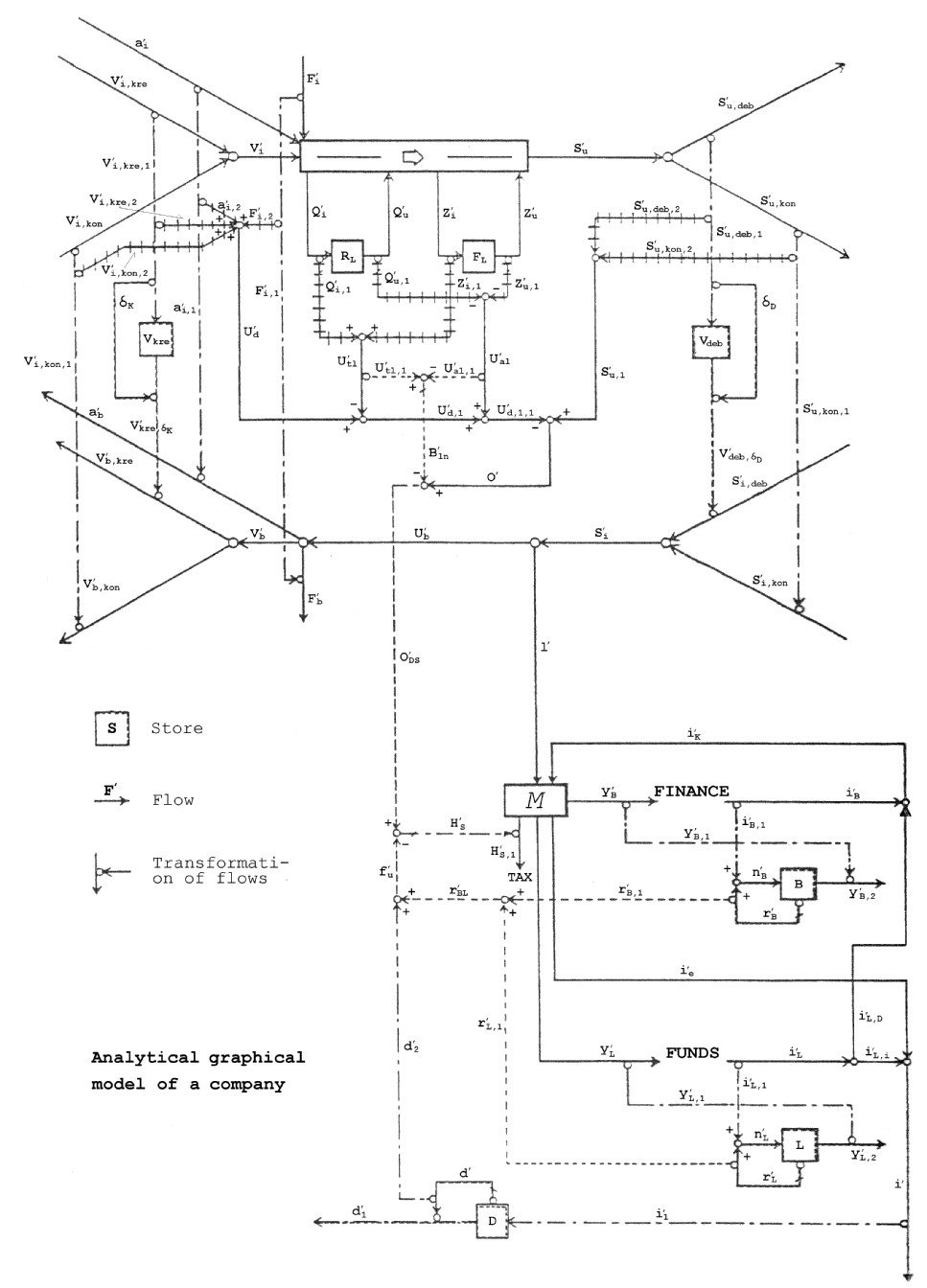
Figure
2.1
(Click
on the figure for 200%)
.
- 22 -
The following equation applies:
V'i(t) = V'i,kre(t) + V'i,kon(t)
(89)
The firm is supplied with the fixed
volume of resources per time unit F'i. This flow of resources may,
for example, include electricity, administration, heating, rent, etc.
2.1.3.
Inventories
The
volume of raw materials per time unit Q'i is added to the raw mate-
rials inventory consisting of the volume
RL. From the raw materials in-
ventory is deduced the raw materials volume Q'u. The following equation
applies here:
t
RL = ò (Q'i(t) - Q'u(t))dt (90)
0
The
volume of finished goods per time unit Z'i is added to the finished
goods
inventory consisting of the volume FL. From the finished goods
inventory is deduced the finished goods
volume Z'u. The following equa- tion applies here:
t
FL = ò(Z'i(t) - Z'u(t))dt
(91)
0
2.2. Payment parameters, operations
2.2.1. Sales
The total volume of means of payment per
time unit from the customers is denoted with S'i. This payments flow consists of
two components. One component is the payments flow S'i,kon stemming from the cash sales
flow
S'u,kon. The other component S'i,deb is the payments flow stemming
from the credit sales flow S'u,deb. Here the following equation
applies:
S'i(t) = S'i,kon(t) + S'i,deb(t)
(92)
.
- 23 -
2.2.2. Purchases
The total volume of means of payment per
time unit for operations is denoted with U'b. This payments flow is
composed of three components, a'b and V'b and F'b. a'b is the payments flow
corresponding to the flow of hours consumed a'i, V'b is the payments flow
corresponding to the flow of raw material purchases V'i, F'b is the payments flow
corresponding to the flow of fixed resources consumed F'i. The following equation
applies:
U'b(t) = a'b(t) + V'b(t) + F'b(t) (93)
The payments flow V'b is made up of two components.
One component is the payments flow V'b,kon corresponding to the cash
purchases of rawmaterials V'i,kon; the other component is the
payments flow V'b,kre corresponding to the credit
purchase of raw materials V'i,kre. The following equation
applies:
V'b(t) = V'b,kon(t) + V'b,kre(t)
(94)
2.3.
Market parameters, sales
With a viev to depicting the fundamental
financial effects of the mar- ket on the firm as well as its effects on
earnings the market is cha- racterized by three basic components q , p and dD. They also describe the
fundamental link between the firm's sales of goods and the related payments
flows.
2.3.1.
Cash sales ratio q
The cash sales ratio is defined by the
equation;
S'u,kon(t) = q S'u(t) (95)
where 0 £ q £
1
In a manufacturing business q will typically be placed in the in-
terval 0 £ q
£ 0.2.
In a supermarket q will typically be in the interval 0.8 £ q £ 1.
.
- 24 -
2.3.2.
The price p
The price of the firm's product(s) is
defined by the eguations
S'u,kon,1(t) = p S'u,kon(t) (96)
S'i,kon(t) = S'u,kon,1(t)
(97)
where S'u,kon,1(t) is the flow of debts
corresponding to the sales flow S'u,kon(t) (i.e. the current sending
out of invoices stating the amount of debt; see equation (96)). Equation
(97) expresses the fact that the flow of debts S'u,kon,1(t) is equal to the payments
flow from the customers (cash payment).
In practice, it should be noted that
there is normally only a tempora- ry time lag between invoicing and sales.
However, it has a temporary negative effect on liquidity and the
computation of results. Manage- ment will therefore as far as possible make
sure that invoicing is done without the mentioned delays.
2.3.3.
Debit time dD
This model defines the debit time dD as the time from the time of
de- livery of the goods from the firm until the time of payment by the cu-
stomer for the goods. In practice, dD is spread over the individual cu- stomers but with well defined
terms of payment the mean value can be adopted.
The definition of dD can be expressed by the
equations
S'u,deb,1(t) = p S'u,deb(t)
(98)
V'deb,dD(t) = S'u,deb,1(t - dD) (99)
S'i,deb(t) = V'deb,dD(t) (100)
.
- 25 -
S'u,deb,1 refers here to the invoice
flow corresponding to the credit sales flow S'u,deb cf. equation (98). Equation (99)
gives a funational description of a function V'deb,dD(t), which can be defined as
the pay- ments flow (documents) corresponding to the actual receipt of
payments S'i,deb(t) cf. equation (100). In practice, no
time lag is found between the two last mentioned functions.
In pratice, attention should be paid to
the fact that there may be a time lag in the business between invoicing and
sales, the result being changes in liquidity and the computation of
earnings. Management usu- ally aims at applying equation (98) in practice,
i.e. no time lag.
2.4. Market parameters, purchases
With a view to depicting the fundamental
financial effects of the pur- chasing market on the firm as well as its
effects on costs, it is cha- racterized by four basic components epsilon, q1, q2 and dK. They describe the
fundamental link between the firm's purchases of resources and the related
payments flows.
2.4.1.
Cash purchases ratio e
The cash purchases ratio is defined by
the equation:
V'i,kon(t) = e V'i(t) (101)
where 0 £ e £
1
In, say, a manufacturing business e will typically be placed in the interval
0 £ e £ 0.2.
This is also a typical feature in a trading firm.
2.4.2.
The price q1 of raw materials
The price of the firms raw materials is
defined by the equation:
.
- 26 -
V'i,kon,1(t) = q1 V'i,kon(t) (102)
V'b,kon(t) = V'i,kon,1(t)
(103)
where V'i,kon,1(t) is the flow of debts
corresponding to the raw materials flow V'i,kon(t) (i.e. the current receipt
of invoices stating the amounts of debts); see equation (102). Equation
(103) expresses the fact that the flow of debts V'i,kon,1(t) is equal to the payments
flow to suppliers (cash payment).
In practice, attention should bepaid to
the fact that the time lag between the supplier's invoicing and the
supplies of raw materials is usually a temporary feature which has a
temporary positive affect on liquidity and the computation of results.
2.4.3. The price q2 of labor hours
The price of the firm's labor hours is
defined by the equations
a'i,1(t) = q2 a'i(t) (104)
a'b(t) = a'i,1(t) (105)
where a'i,1(t) is the time ticket flow
corresponding to the flow of labor hours used a'i(t) (i.e. the current issuing
of time tickets stating wages earned); see equation (17). Equation (18)
expresses the fact that the time ticket flow a'i,1(t) is equal to the time rate
flow a'b(t).
In practice there is a certain time lag
between functions on the right hand side and the left hand side of the
equal sign in equation (104). This time lag is ignored here. There is
usually no time lag between
the functions of equation (105), or the
time lag is relatively small and of no importance here.
.
- 27 -
2.4.4. Credit time dK
This model defines the credit time dK as the time from the time of de-
livery of the raw materials to the firm until the time of payment by the
firm for the raw materials. In practice, dK is spread over the in-
dividual suppliers but with well defined terms of payment the mean va- lue
can be used. The definition of dK can be expressed by the equati- ons:
V'i,kre,1(t) = q1 V'i,kre(t) (106)
V'kre,dK(t) = V'i,kre,1(t - dK)
(107)
V'b,kre(t) = V'kre,dK(t) (108)
where V'i,kre,1(t) refers here to the invoice
flow corresponding to the
credit purchases flow V'i,kre(t), cf. equation (106).
Equation (107) gi-ves a functional description of a function V'kre,dK(t) which can be defined as
the payment order flow (documents) corresponding to the actual effecting of
payments V'b,kre(t), cf. equation (108). In practice,
there is no time lag between the two last mentioned functions.
In practice, attention should be paid to
the fact that the time lag between the supplier's invoicing and the
supplies of raw materials is usually a temporary feature which has a
temporary positive affect on liquidity and the computation of results.
The following equations are defined in
relation to the fixed resources consumed F'i and the related fixed costs F'b.
F'i,1(t) = k F'i(t)
(109)
F'b(t) = F'i,1(t)
(110)
.
- 28 -
where F'i,1(t) in equation (109) refers to
the flow of debts in the form of invoices (stating amounts) corresponding
to the fixed resoures flow F'i(t). k denotes a symbolic operator in the form
of an average price of the fixed resources unit. In practice, there is some
time lag between the functions in eguation (110). As, however, the fixed
costs by definition are constant in time, such a time lag is not important
in this context.
3.1 Income statement
In this Chapter an income statement for
operations is presented (be- fore depreciation, etc.) using the general
main principles of accoun- ting theory.
3.1.1 Sales of goods
Sales of goods are defined on the basis
of the following equations:
S'u,kon,2(t) = S'u,kon,1(t)
(111)
S'u,deb,2(t) = S'u,deb,1(t)
(112)
S'u,1(t) = S'u,kon,2(t) + S'u,deb,2(t) (113)
Eguation (111) expresses the fact that
the flow of debts (in the form of invoices with statement of amounts) S'u,kon,1(t) gives rise to an e- qually
large information flow S'u,kon,2(t). This quantity is
identital with the current crediting to the cash sales account.
From equation (112) follows that the flow
of debts S'u,deb,1(t) causes an equally large information
flow S'u,deb,2(t). This quantity is iden-
tical to the current crediting to the credit sales account.
Total uales in the form of the
information flow S'u,1(t) corresponding to the total
crediting to the sales account are then obtained from e- quation (113).
.
- 29 -
3.1.2
Costs
The costs of the firm in connection with
production and sales are de- fined by the following equations:
V'i,kon,2(t) = V'i,kon,1(t)
(114)
V'i,kre,2(t) = V'i,kre,1(t) (115)
a'i,2(t) = a'i,1(t)
(116)
F'i,2(t) = F'i,1(t)
(117)
U'd(t) = V'i,kon,2(t) + V'i,kre,2(t) + a'i,2(t) + F'i,2(t) (118)
Equation (114) expresses the fact that
the invoice flow from the cash purchase V'i,kon,1(t) is corrently debited to
the cash purchases account
to
the extent of the cash flow V'i,kon,2(t).
Equation (115) expresses the fact that
the invoice flow from the cre- dit purchase V'i,kon,1(t) is currently debited to
credit purchases account to the extent of the cash flow V'i,kre,2(t).
Equation (116) denotes the functional
relationship between the time ticket flow a'i,1(t) and the current debiting to
the time rate account of the wage payment flow a'i,2(t).
Equation (117) expresses the functional
relationship between the in- voice flow F'i,1(t) for fixed costs and the
current debiting of the cash flow F'i,2(t) to the fixed costs
account.
The total cost flow is defined by
equation (118).
.
- 30 -
3.1.2.1
Inventories, additions (with signs)
By way of introduction, it is mentioned
that the signs relating to additions to inventories (as a mean time value)
are assumed to be the same as those relating to additions to sales (as a
mean time value). Against this background the additions to the individual
inventories will for principal planning purposes have the same signs. The
inventories only serve as "standby stores" in case of emergancy events"
i.e. in normal operation state "the materials and products go directly
through the factory. Thus, the following systems of equations apply:
Q'i(t) > 0
Q'u(t) = 0
d S'u
¾¾¾¾ > 0 Þ (119)
dt
Z'i(t) > 0
Z'u(t) = 0
Q'i(t) = 0
Q'u(t) = 0
d S'u
¾¾¾¾ = 0 Þ (120)
dt
Z'i(t) = 0
Z'u(t) = 0
Q'i(t) = 0
Q'u(t) > 0
d S'u
¾¾¾¾ < 0 Þ (121)
dt
Z'i(t) = 0
Z'u(t) > 0
.
- 31 -
The system of equations (119) denotes
that inventories rise when sales rise.
The system of equations (120) denotes that
inventories are constant when sales remain unchanqed.
The system of equations (121) denotes
that inventories fall when sales fall.
Based on these main principles for the
model the following equations can be developed.
Q'i,1(t) = qR Q'i(t) (122)
Q'u,1(t) = qR Q'u(t) (123)
Z'i,1(t) = qF Q'i(t) (124)
Z'u,1(t) = qF Z'u(t) (125)
U'tl(t) = Q'i,1(t) + Z'i,l(t)
(126)
U'al(t) = Q'u,1(t) + Z'u,1(t)
(127)
where
Q'i,1(t)
is the flow of additions to raw materials invento-
ries corresponding to the additions to
rawmateri-
als inventory records with statement of
amounts.
Q'u,1(t)
is the flow of deductions to raw materials invento-
ries corresponding to the deductions to raw
mate-
rials inventory records with statement of
amounts.
Z'i,1(t)
is the flow of additions to finished goods invento-
ries corresponding to the additions to
finished
goods inventory records with statement of
amounts.
.
- 32 -
Z'u,1(t)
is the flow of deductions to finished goods inven-
inventories corresponding to the deductions
to fi-
nished goods inventory records with
statement of
amounts.
qR denotes the caiculated rav material price
per unit
of finished goods.
qF denotes the caiculated direct cost
price per unit
of finished goods.
U'tl(t)
is total additions to inventories.
U'al(t)
is total deductions from inventories.
The system of equations (119), (120) and
(121) can nov be given the form:
d S'u
¾¾¾¾
> 0 Þ U'tl(t) > 0
and U'al(t) = 0 (128)
d t
d S'u
¾¾¾¾
= 0 Þ U'tl(t) = 0
and U'al(t) = 0 (129)
d t
d S'u
¾¾¾¾
< 0 Þ U'tl(t) = 0
and U'al(t) > 0 (130)
d t
Attention is dravn to the fact that the
physical model based on the FIFO principle can be deseribed mathematically
only by
d S'u
sign ( ¾¾¾¾ ) = sign (U'tl(t)) (131)
d t
given U'al(t) = 0 (132)
and U'tl(t) is computed with signs.
.
- 33 -
3.1.3.
Resourceconsumption (incl. F'i,1)
Resources consumed U'd,1,1(t) can be defined by the
following equations:
d S'u
¾¾¾¾
> 0 Þ U'd,1,1(t) = U'd(t) - U'tl(t)
(133)
d t given U'al(t) = 0
d S'u
¾¾¾¾
= 0 Þ U'd,1,1(t) = U'd(t) (134)
d t
d S'u
¾¾¾¾
< 0 Þ U'd,1,1(t) = U'd(t) - U'al(t)
(135)
d t
given U'tl(t) = 0
3.1.4.
Operation profit (before interest and depreciation)
The operating profit (before interest and
depreciation etc.) is defi- ned by the equation:
O'(t) = S'u,1(t) - U'd,1,1(t) (136)
3.1.5
Operating profit incl. inventory depreciation
If a tax year of the length T is
considered in a period of time
t1 £ t £
t1 + T where t1 is a time selected at random,
the following
functions can be defined:
t1+T
Vkøb = ò q1 V'i(t) dt
(137)
t1
w = w(t1) (138)
an = an(t) (139)
In equation (137) Vkøb represents the purchases of goods
in the period t1 £ t £ t1 + T.
Equation (138) defines w(t1) as the total inventory value
at time t1.
an(t) in the equation defines
the inventory depreciation rate.
.
- 34 -
Materials consumed computed for tax
purposes is then derived from the following equation (140):
Vskat = Vkøb + w(t1) - (w(t1)/(1 - an(t1))
t1+T
+ ò (U'tl(t) - U'al(t)) dt) (1 - an(t1 - T)) (140)
t1
For principal planning purposes the mean
time value of an(t) for a given business will
be a constant an and limited i.e.
0 < an < 0.3 . Based on this
assumption equation (140) gives
t1+T
Vskat = Vkøb - (1 - an) ò (U'tl(t) - U'al(t)) dt (141)
t1
Materials consumed for operations is
defined by the following equation
(54a):
t1+T
Vdrift = Vkøb + w(t1) - (w(t1) + ò (U'tl(t) - U'al(t)) dt) (141a)
t1
or
t1+T
Vdrift = Vkøb - ò (U'tl(t) - U'al(t)) dt) (142)
t1
If equation (142) and equation (141) are
combined, the following equations are developed:
t1+T
Vskat = Vdrift + an ò (U'tl(t) - U'al(t)) dt (143)
t1
t1+T
Vskat = Vdrift + ò an(U'tl(t) - U'al(t)) dt (144)
t1
.
- 35 -
On the basis of equation (144) the
following functions can be defined:
U'tl,1(t) = U'tl(t) (145)
U'al,1(t) = U'al(t)
(146)
In equation (145) U'tl,1(t) denotes total additions to
inventories from a taxation point of view. U'al,1(t) denotes in equation (146)
total de-ductions from inventories from a taxation point of view.
With the following definition equation:
B'ln(t) = an (U'tl,1(t) - U'al,1(t)) (147)
equation (144) can be transformed into
t1+T
Vskat = Vdrift + ò B'ln(t) dt
(148)
t1
On the basis of equation (148) the
following equation (149) can be defined:
O'DS = O' - B'ln (149)
where O'DS is the operating profit
adjusted for inventory depreciation.
4.1. Change in liquidity (operations)
The cash flow released by operations, the
change in liquidity, is de- fined by the following equation (150):
l'(t) = S'i(t) - U'b(t) (150)
.
- 36 -
5.1. Cash balance
The cash balance of the firm is
designated by M, which, in relation to the present principal planning
model, is very small in practice, i.e. M(t) = 0. The following equation can
now be developed:
i'e = l' + i'K - y'B - y'L - H'S,1 (152)
where
i'e is the self financing flow
y'B is the service of bank loans
y'L is the service of other loans
i'K is current raise of loans for operations
H'S,1 is tax payments
5.2. Bank loans
The firm is financed currently by trading
credits in the form of the cash flow i'B. The equation is defined as
follows:
i'B,1(t) = i'B(t)
(152)
where i'B,1(t) is the information flow in
the form of loan documents with statement of amounts corresponding to the
cash flov i'B(t). The bank charges currently interest r'B(t) on the amount outstanding
B = B(t) where r'B(t) is the document flow with
statement of interest. The following equation appliess:
n'B(t) = i'B,1 + r'B
(153)
where n'B(t) is the firm's current
crediting to the bank account.
.
- 37 -
The current service payments y'B(t) to the bank give rise to a
payment order flow with statement of amounts y'B,1(t). We have:
y'B,1(t) = y'B(t) (154)
The payRent order flov y'B,1(t) involves a corresponding current
debi- ting to the bank account in the form of y'B,2(t). The following equati- on
therefore applies:
y'B,2(t) = y'B,1(t)
(155)
5.3. Loans (long term)
The long term financing of the business is
represented by the cash flow i'L. The following equation
applies:
i'L,1(t) = i'L(t)
(156)
where i'L,1(t) is the information flow in
the form of loan documents with statement of amounts corresponding to the
cash flow i'L(t). On the loan L current interest r'L(t) is charged where r'L(t) is the document flow with
statement of interest. The following equation applies:
n'L(t) = i'L,1(t) + r'L(t)
(157)
where n'L(t) is the firm's total
current crediting to the loan account.
The following equation applies:
i'L(t) = i'L,1(t) + i'D(t)
(158)
where i'L,D(t) denotes the long term
financing flow to the working ca- pital, and i'L,1(t) is the long term financing
flow to the fixed capi- tal.
.
- 38 -
The following equation applies:
i'K(t) = i'B(t) + i'L,D(t) (159)
The current service payments y'L(t) to lender give rise to a payment
order flow with statement of amounts y'L,1(t). We have
y'L,1(t) = y'B(t) (160)
The payment order flow y'L,1(t) involves a corresponding
current debi-ting to the loan account in the form of y'L,2(t). The following equati- on
therefore applies:
y'L,2(t) = y'L,1(t)
(161)
6.1. Investment
(in fixed capital)
The firm's current investment in fixed
capital is denoted i'(t). The following equation applies:
i'(t) = i'L,1(t) + i'e(t) (162)
It is pointed out that, in practice, i'L,D(t) currently converts short
term liabilities into long term liabilities, which means that at a
strategic level alone i'L,D = 0. As to i'e(t), there is no unique defi-
nition of i'e(t) as it depends on the financing and market situation.
Roughly speaking, i'e(t) is the average cash flow
which can be with- drawn from the business without changing the existing
product, invest- nent and financing structure and the necessary financial
reserves set aside for an appropriate future development of the businees.
.
- 39 -
7.1. Depreciation (for tax purposes)
It is normal to distinguish between
depreciation for tax purposes and depreciation for accounting purposes.
Depreciation for accounting pur- poses is used with the object of comparing
alternative projects on the basis of special cost principles, which, for
example, are mentioned in connection with equation (4). These principles
are pure- ly OR mathe- matical models and do not reflect the physical
business situation.
Here we shall only take an overall view
of the financial flow of the firm for which reason depreciation for tax
purposes will be used. Such depreciation will only reflect the actual
effects on liquidity (after tax).
The following equations apply:
i'1(t) = i'(t) (163)
t
D(t) = ò (i'1(t) - d'1(t))dt (164)
0
where i'1(t) represents the current
debiting to the tax depreciation account corresponding to the investment
flow i'(t). d'1(t) is the cur- rent crediting
to the same account (i.e. current "depreciation").
D(t) represents the balance of the tax
depreciation account. The de- preciation charges d'(t) are calculated on the
basis of this account, and the following expressions apply:
d'1(t) = d'(t) (163a)
d'2(t) = d'(t) (164a)
where d'2(t) is the depreciation flow
which is inciuded in the basis of computation of the taxable income.
.
- 40 -
8.1.
Interest (for tax puroses)
Interest is usually computed for two main
purposes. One concerns the income statement for tax purposes, the other
concerns internal compu- tation purposes such as the effect of interest on
the income statement as a whole or in connection with special computations.
No distinction will be made here between
the two purposes. The inter- est charges will be placed in this model with
the sole aim of depic- ting the fundamental financial characteristics.
The following equations are defined:
r'B,1(t) = r'B(t)
(165)
r'L,1(t) = r'L(t)
(166)
r'BL(t) = r'B,1(t) + r'L,1(t)
(167)
where r'B,1(t) denotes the current
recording of interest payment to the
bank. r'L,1(t) denotes the current
recording of interest payments to other lenders. The recording of total
interest payments is designated r'BL(t).
9.1.
Tax payments
According to the principles governing
computation of the taxable income the following equations apply:
f'u(t) = d'2(t) + r'BL(t)
(168)
H'S(t) = s (O'DS(t) - f'u(t))
(169)
H'S,1(t) = H'S(t)
(169a)
.
- 41 -
where f'u(t) is a state function for
the computation of tax, cf. equa- tion (168), s is the tax rate, H'S(t) is the computed tax
payment and H'S,1(t) is the tax payment flow.
10.1. Principal ratios
As appears from Fig. 2.1, the following
principal ratios in the firm are important to the understanding of the
dynamic (tactical) characte- ristics of the firm.
Operating
profit O'(t)
Change
in liquidity l'(t)
Working
capital (net) K'(t)
Contribution
ratio DG(t)
Depreciation
d'2(t)
Interest r'BL(t)
These ratios will be discussed in detail
in the following.
10.1.1. Operating profit O'(t)
Using different assumptions concerning
prices and changes in principal assets (accounts payable, accounts
receivable, inventories) it is pos- sible via Fig. 2.1 to assess the
effects on the operating profit. A reduction of the raw materials
inventories in a situation with raw ma- terials prices which are higher
than the prices of the raw materials inventories but othervise constant
will increase the profit temporari- ly in the period concerned.
One of the things that will be seen is
that the profit O'(t) is inde- pendent of the volume of trade accounts payable
and the volume of tra- de accounts receivable.
- 42 -
10.1.2.
Change in liquidity l'(t)
Other things being equal, the following
expression, cf. Fig. 2.1., ap- plies:
d S'u
¾¾¾¾ > 0 Þ l'(t) < O'(t) (170)
d t
Equation (170) shows that the profit O'(t) is larger than the change
in
liquidity in the case of growing sales in
the firm, the reason being the funds tied up, calculated with signs, in principal
assets (ac-
counts receivable and inventories),
d S'u
¾¾¾¾
= 0 Þ l'(t) = O'(t) (171)
d t
Equation (171) shows that the change in
liquidity is equal to the pro-fit in the case of constant sales, the reason
being an unchanged volu- me of principal assets (accounts payable, accounts
receivable and in- ventories).
d S'u
¾¾¾¾
< 0 Þ l'(t) > O'(t) (172)
d t
From equation (172) appears that in the case
of falling sales the change in liquidity becomes greater than the operating
profit owing to a reduced volume of principal assets (accounts payable,
accounts receivable and inventories).
The above shows how important it is for
the business to keep the cash budget currently up to date as the profit and
the financial circum- stances of the business may differ substantially from
each other. It should be noted that if the net principal assets are
negative, the inequality signs in (170) and (172) must be reversed.
.
- 43 -
10.1.3.
Working capital K(t).
If the working capital is denoted K(t),
the definition eguation for net capital tied up in the operating system
will apply:
K(t) = Vdeb(t) + FL(t) + RL(t) - Vkre(t) (173)
The following definition equation will
also apply:
d K(t)
¾¾¾¾
+ l'(t) = O'(t) (174)
d t
Equation (174) shows that the profit is
equal to the change in liqui- dity + the increment of the net working capital
tied up.
If equation (174) is transformed, the
following equation is derived:
d K(t)
¾¾¾¾
= O'(t) - l'(t) (175)
d t
Equation (175) denotes that the
difference between the operating pro- fit and the change in liquidity is
equal to the financing requirements for operations in the period under
review.
10.1.4.
Contribution ratio DG(t)
The contribution ratio is defined by
equation (176):
DG(t) = (O'(t) + F'b(t))/S'u,1(t) (176)
Equation (176) shows that DG is
independent of the amount of sales and defines the share of sales which
will cover fixed costs, etc. The point is stressed here that a high
contribution ratio does not imply that there is "money" to cover
the fixed costs. For further details see section 10.1.2. as the size of l'(t) gives only an indication
of the ability of the firm to pay fixed costs, etc.
.
- 44 -
10.1.5. Depreciation
Depreciation contributes to influencing the
firm's liquidity, cf. e- quation (169). Assuming that the investments are
made as individual projects at time intervals, it is shown that
depreciation in the peri- ods between investments causes liquidity to rise
owing to the reducti- on in tax payments.
However, it should be noted that of the
cash flow released after tax there must be funds to cover repayment
commitments in connection with loans raised. The effect of the cash flow
released after tax described above is therefore partial and must be seen in
relation to the repay- ment commitments.
In chapter C will be shown that for
practical reasons the division described here is desirable for the
understanding of the financial components of the cash flow released.
10.1.6.
Interest r'BL
From Fig. 2.1 and from equations (168)
and (169) is apparent that in- terest payments reduce the cash flow
released after tax. Thus, the net effect on cash flow released (to be defined in
charter C) stems partly from the computation of income for tax purposes,
partly from the pay- ment of interest on total loans.
The computation of interest on total
loans seen in relation to a given level of activity will be defined later.
.
C H A P T E R
C
.
- 45 -
11.
An analytical mathematical business model
This Chapter presents a new analytical
mathematical model description of the business. This model has been
developed for use in the tactical planning process. No reference can be
made to a similar model in exist- ing literature. The theoretical
literature which gets nearest is S. Eilon's article discussed in Chapter A
in the thesis.
11.1.
Physical and financial functions in the operating system
In the following further definitions of
mathematical functions and their relationships will be established. The
sole justification of these defi- nitions is that they provide the basis of
a clear and generally coherent system of equations between ratios.
11.1.1.
Sales
A basic sales volume is defined:
S'u0 = S'u(0) (177)
where S'u0 is the volume of sales S'u at time t = 0, i.e. at the
beginning of the simulation period.
The development of sales during the time
period is defined by equation (91):
d S'u(t)
¾¾¾¾ = as S'u0 (178)
d t
where as is constant.
.
- 46 -
The following equation now applies:
S'u(t) = S'u0(1 + as t) (179)
where t ³ 0
11.1.2.
Inventories.
Let a ratio hF be defined so that equation
(180) applies:
hF = FL(t)/S'u(t)
(180)
for t ³ 0, hF being a positive constant
which is designated "finished goods inventory time". Another ratio
hR is defined so that equation
(181) applies:
hR = RL(t)/S'u(t)
(181)
for t ³ 0 being a positive constant which is designated "raw
materi- als inventory time".
From equation (180) follows:
FL(t) = hF S'u(t)
(182)
The definition equation applies:
t
FL(t) = FF(0) + ò Z'i(t) dt (183)
0
which substituted into equation (182) gives:
.
- 47 -
t
FL(0) + ò Z'i(t) dt = hF S'u(t) (184)
0
or
t
ò Z'i(t) dt = hF S'u(t) - FL(0) (185)
0
If equation (179) is used in equation (185),
the following expression is derived:
t
ò Z'i(t) dt = hF S'u0 as t + (hF S'u0 - FL(0)) (186)
0
For t = 0 equation (180) gives the
following expression:
hF = FL(0)/S'u(0) (187)
Using equation (187) together with
equation (186) we have:
t
ò Z'i(t) dt = hF S'u0 as t (188)
0
The solution to the integral equation
(188) is:
Z'i(t) = hF S'u0 as (189)
The flow of goods Z'i(t) to the finished goods
inventory may then be defined by equations (190) and (191):
Z'i(t) = hF S'u0 as (190)
for as ³ 0
and
Z'u(t) = - hF S'u0 as (191)
for as < 0
.
- 48 -
Mathematically the physical equations
(190) and (197) may be described by equation (192) for all values of as, i.e.
Z'i(t) = hF S'u0 as (192)
for
- ¥ < as < ¥
With equation (192) the physical
inventory system has been converted to a mathematical model where Z'i(t) can change sign and where
Z'u(t)
= 0 for all t, cf. equation (189).
From equation (181) follows:
RL(t) = hR S'u(t) (193)
The definition equation applies:
t
RL(t) = RL(0) + ò Q'i(t) dt (194)
0
which combined with equation (193) gives:
t
RL(0) + ò Q'i(t) dt = hR S'u(t) (195)
0
or
t
ò Q'i(t) dt = hR S'u(t) - RL(0) (196)
0
If equation (179) is used in equation
(196), the following equation is
derived:
t
ò Q'i(t) dt = hR S'u0 as t + (hR S'u0 - RL(0)) (197)
0
For t = 0 equation (181) gives:
.
- 49 -
hR = RL(0)/S'u(0) (198)
Using equation (197) together with
equation (198) we have:
t
ò Q'i(t) dt = hR S'u0 as t (199)
0
The solution to the integral equation
(199) is:
Q'i(t) = hR S'u0 as
(200)
The flow of goods Q'i(t) to the raw materials inventory
can now be de- fined by equations (201) and (202):
Q'i(t) = hR S'u0 as
(201)
for as ³ 0
Q'u(t) = - hR S'u0 as (202)
for as < 0
Mathematically the physically equations
(201) and (202) can be descri-
bed by equation (203) for all values of as, i.e.
Q'i(t) = hR S'u0 as
(203)
for
- ¥ < as < ¥
With equation (203) the physical
inventory system has been converted to a mathematica1 model where Q'i(t) can change sign and where
Q'u(t) = 0 for all t.
.
- 50 -
11.1.3.
Output
Total output T'p(t) is given by:
T'p(t) = S'u(t) + Z'i(t) (204)
If the ratio ba is here defined as the number
of labor hours used per unit of output and the ratio bR as the raw materials
consumption per unit of finished goods, the equations, resource balance
equations, will apply:
a'i(t) = ba T'p(t) (205)
V'i(t) = bR T'p(t) + Q'i(t) bR
(206)
If equation (204) and equation (206) are
combined, the following equa- tion is obtained:
V'i(t) = bR S'u(t) + bR Z'i(t) + Q'i(t) bR (207)
If equations (179), (192) and (203) are
substituted into equation (207), the following equation is obtained:
V'i(t) = bR S'u0 (1 + (hF + hR + t) as) (208)
Using equations (204), (179) and (192),
equation (205) gives:
a'i(t) = ba S'u0 (1 + as(t + hF)) (208a)
11.1.4. Sales, ingoing payments
Using equations (95), (96) and (97) we
obtain payments derived from cash sales:
S'i,kon'(t) = p q S'u0 (1 + as t) (209)
.
- 51 -
Using equations (88), (95), (98), (99)
and (100) we obtain payments derived from debit sales:
S'i,deb(t) = p (1 - q) S'u0 (1 + as(t - dD)) (210)
Equations (88), (209) and (210) give:
S'i(t) = p q S'u0 (1 + as t) + p (1 - q) S'u0
(1 + as(t - dD)) (211)
or
S'i(t) = p S'u0 (1 + as(t - dD(1 - q))) (212)
11.1.5.
Purchases, outgoing payments
The outgoing payments flow corresponding
to cash purchases of raw ma- terials is expressed by means of equations
(101), (102), (103) and (208) as
V'b,kon(t) = q1 e bR S'u0 (1 + (hF + hR + t)as) (213)
Credit purchases of raw materials cause
an outgoing payments flow which by means of equations (94) (101), (106),
(107) and (108) is computed at:
V'b(t) = e q1 V'i(t) + (1 - e)q1 V'i (t - dK) (214)
Equation (214) is transformed by means of
equation (208) into:
V'b(t) = e q1 bR S'u0(1 + (hF + hR + t) as) +
(1 - e)q1 bR S'u0(1 + (hF + hR + t - dK)as) (215)
Equation (215) is reduced to:
V'b(t) = q1 bR S'u0(1 + as(hF + hR + t - dK (1 - e))) (216)
.
- 52 -
The total payments flow to purchases of
resources is then obtained by using equations (93), (104), (105) and (216):
U'b(t) = q2 a'i(t) + q1 bR S'u0(1 + as (hF + hR + t - dK
(1 - e))) + F'b(t) (217)
By substituting equation (208a) into
equation (217) the total outgoing payments flow is then given by:
U'b(t) = S'u0(q2 ba (1 + as (t + hF)) + q1 bR(1 + as
(hF + hR + t - dK(1 - e))) + F'b(t) (218)
11.1.6.
Change in liquidity
The accounting concept, change in
liquidity l'(t),
here also called cash flow, can then by the use of equations (150), (212)
and (218) be given the following form:
l'(t) = S'u0(p(1 + as(t - dD(1 - q)))
- q2 ba (1 + as(t + hF)) - q1 bR(1 + as
(hF + hR + t - dK(1 - e)))) - F'b(t) (219)
11.2.
Capital tied up in the operating system
Depending on the firm's level of activity
capital will be tied up in the operating system. Capital will be tied up in
trade accounts payable, raw materials inventories and finished goods
inventories as well as accounts receivable (the amounts are indicated with
signs).
11.2.1. Trade accounts receivable
The volume of trade accounts receivable
is defined by the following equation, equations (88), (95), (98) and (99)
being used:
dD
Vdeb(t) = ò p(1 - q)S'u(t - x) dx (220)
0
.
- 53 -
In this model it is assumed that equation
(179) applies. From this equation combined with (220) follows:
dD
Vdeb(t) = p(1 - q) S'u0 ò (1 - as(t - x))
dx (221)
0
The computation of the integral in
equation (221) allows equation (221) to be reduced to:
Vdeb(t) = p(1 - q) S'u0 dD (1 + as(t - 0.5 dD)) (222)
11.2.2.
Trade accounts payable
The volume of trade accounts payable is
defined by the following equation, equations (89), (101), (106) and (107)
being used:
dK
Vkre(t) = ò q1 bR(1 - e) V'i(t - x)) dx (223)
0
Assuming that sales satisfy equation
(179) and that equation (208) applies, equation (223) develops the
following expression:
dK
Vkre(t) = q1 bR(1 - e) S'u0 ò (1 + as(hF + hR + t - x)) dx (224)
0
By computing the integral in equation
(224) this equation is reduced to:
Vkre(t) = q1 bR(1 - e) S'u0 dK (1 + as(hF + hR + t - 0.5 dK)) (225)
l1.2.3
Raw materials inventory
The volume of the raw materials inventory
is given by equation (193). The value of the raw materials inventory RL,1(t) satisfies the equation:
RL,1(t) = q1 bR RL(t)
(226)
.
- 54 -
If equations (193) and (179) are
substituted into equation (226), we have:
RL,1(t) = q1 bR hR S'u0(1 + as t) (227)
11.2.4.
Finished goods inventory
The volume of the finished goods
inventory is given by equation (182). The calculated consumption of
materials and labor hours per unit of finished goods is given by qF, cf. equation (124). The
definition equa- tion applies:
qF = bR q1 + ba q2 (228)
The value of the finished goods inventory
FL,1(t) satisfies the equati- on:
FL,1(t) = qF FL(t) (229)
If equations (182), (179) and (228) are
substituted into equation (229), the following expression is obtained:
FL,1(t) = (bR q1 + ba q2) hF S'u0(1 + as t) (230)
11.2.5.
Working capital (tied up in the operating system)
The total capital tied up in the
operating system, i.e. the working capital K(t), is through the use of
equations (222), (225), (227) and (230) given by:
K(t) = Vdeb(t) - Vkre(t) + RL,1(t) + FL,1(t) (231)
or by substituting into the relevant
places
K(t) = p(1 - q)S'u0 dD (1 + as(t - 0.5 dD))
- q1 bR (1 + e)S'u0 dK (1 + as(hF + hR + t - 0.5 dK))
+ q1 bR hR S'u0(1 + as t)
+ (bR q1 + ba q2) hF S'u0(1 + as t)
or
.
- 55 -
K(t) = S'u0(1 + as t)(hF (bR q1 + ba q2) + q1 bR hR)
+ p(1 - q) dD S'u0(1 + as(t - 0.5 dD))
- q1
bR (1 - e) dK S'u0(1 + as(hF + hR + t - 0.5 dK)) (232)
12.1.
Operating profit (for accounting purposes)
In the following, functions are
established for the computation of operating profit based on accounting
theory.
The turnover of the firm is obtained by
using equations (96), (98), (111), (112) and (113) and is expressed as:
S'u,1(t) = p S'u(t)
(233)
Using equation (233) equation (179)
gives:
S'u,1(t) = p S'u0(1 + as t) (234)
Raw materials consumed corresponding to
sales S'u(t) are given by the equation:
V'for(t) = q1 bR S'u(t)
(235)
or by using equation (179):
V'for(t) = q1 bR S'u0(1 + as t) (236)
The wages paid, time rates, corresponding
to sales S'u(t) are given by the equation:
a'for(t) = q2 ba S'u(t)
(237)
or by using equation (179)
a'for(t) = q2 ba S'u0(1 + as t) (238)
.
- 56 -
By using equations (234), (236) and (238)
the operating profit O'(t) can now be given the form:
O'(t) = S'u,1(t) - V'for(t) - a'for(t) - F'b(t) (239)
or
O'(t) = S'u0(1 + as t)(p - (q1 bR + q2 ba)) - F'b (240)
12.2.
Operating profit (computed on the basis of Fig. 1.1)
In this section the operation profit will
as an alternative be compu- ted directly on the basis of Fig. 2.1.
The costs U'd(t) in connection with sales S'u(t) are given by equation
(118). If equations (89), (102), (104), (106), (109), (110), (114), (115),
(116), (117), (208) and (208a) are substituted into equation (118), the
following equation is developed:
U'd(t) = q1 bR S'u0(1 + (hF + hR + t) as)
+ q2
ba S'u0(1 + (hF + t)as) + F'b (241)
Computed with a plus or minus sign
(positive for inventory) the fol- lowing value is added to the raw materials
inventory, cf. equation (35):
Q'i,1(t) = q1 bR Q'i(t)
(242)
or equation (203) may be used:
Q'i,1(t) = q1 bR hR S'u0 as (243)
Here the definition equation for cost
prices of raw materials per unit of finished goods has been used:
.
- 57 -
qR = q1 bR (244)
The following value is added to the
finished goods inventory, cf. equa- tion (124):
Z'i,1(t) = qF Z'i(t) (245)
or equation (189) may be used:
Z'i,1(t) = (q1 bR + q2 ba) hF S'u0 as (246)
The total value flow to inventories now amounts
to, cf. equations (131) and (132):
U'tl(t) = q1 bR hR S'u0 as + (q1 bR + q2 ba) hF S'u0 as (247)
or by reduction
U'tl(t) = S'u0 as(q1 bR hR + (q1 bR + q2 ba) hF) (248)
The total operating profit is obtained by
using equations (234), (241) and (248) and is expressed as:
O'(t) = S'u(t) - (U'd(t) - U'tl)) (249)
or by substituting into the right hand
side:
O'(t) = p S'u0(1 + as t)
- (q1 bR S'u0(1 + (hF + hR + t) as)
+ q2
ba S'u0(1 + (hF + t) as) + F'b
- S'u0 as (q1 bR hR + (q1 bR + q2 ba) hF)) (250)
or by reduction:
.
- 58 -
O'(t) = S'u0(1 + as t)(p -(q1 bR + q2 ba)) - F'b (251)
It will be seen that equations (240) and
(251) are identical, i.e. a systematic use of Fig. 2.1. gives here the same
result as the use of a simple "logical" accounting method.
12.2.1.
Operating profit incl. inventory depreciation
If equations (248) and (145) are
substituted into equation (147), U'tl,1(t) being computed with a plus
or minus sign, the following equation is obtained:
B'ln(t) = an S'u0 as (q1 bR hR + (q1 bR + q2 ba) hF) (252)
The operating profit incl. inventory
depreciation is given by equation (149). If equations (251) and (252) are
substituted into this equation, the following expression is derived:
O'DS(t) = S'u0(1 + as t)(p -(q1 bR + q2 ba)) - F'b
- an S'u0 as (q1 bR hR + (q1 bR + q2 ba) hF) (253)
or by reduction:
O'DS(t) = S'u0((1 + as t)(p -(q1 bR + q2 ba))
- an as (q1 bR hR + (q1 bR + q2 ba) hF)
- F'b (253a)
.
- 59 -
12.3.1.
Bank loans
This model takes as its starting point
that the net working capital tied up K(t) can be given the form:
K(t) = K0 + Kinc(t)
(254)
where K0 is the net working capital
tied up at time t = 0, and Kinc(t) is the change in the working capital
tied up at time t. It is assumed that equation (255) applies:
d Kinc(t)
¾¾¾¾¾
= iB(t)
(255)
d t
This means that the increase in the
capital tied up in the operating system is financed by the bank overdraft.
If equation (255) is used together with
equation (254), the following equation will also apply:
d K(t)
¾¾¾¾¾ = iB(t) (255a)
d
t
It is assumed that:
B(0) = 0 (256)
This means that the overdraft amounts to
DKK B(0) = 0 at time t = 0.
As regards the mathematical model it is
pointed out that in equation (255) i'B(t) may be both positive and
negative as it is also assumed here that, besides equations such as (152),
(153), (154) and (155), the following equation applies:
y'B(t) = r'B(t) (257)
.
- 60 -
12.3.2.
Loans (long term)
It is assumed that i'L(t) is discreet, i.e. that
i'L(t) = 0 and i'D(t) = 0
(258)
for all t > 0, apart from certain
selected times tq where, in practi-ce, changes take place
in financing conditions, and new investments a- re made. Subject to these
assumptions equation (159) may be reduced to
i'K(t) = i'B(t) (259)
with the condition i'L,D(t) = 0
In close connection with the operational financial
possibilities of equations (258) and (259) this model also assumes that
equation (260) applies:
y'L(t) = r'L(t) (260)
12.3.3.
Investments
Investments are defined by i'(t). It is here assumed that i'(t) = 0 apart from certain
times tp corresponding to the forms of
investment seen in practice.
In this mathematical model equation (162)
is changed into:
i'(t) = i'L,i(t) (261)
where i'e(t) becomes the quantity, cash
flow released, for the following purposes:
.
- 61 -
New investments
Instalments on loans
Etc.
This change of equation (162) is
desirable seen in relation to the possibilities of implementing this
mathematical model on a computer.
12.4.1.
Interest payments
From equations (165), (166), (167), (257)
and (260) the total interest payment is derived:
y'B(t) + y'L(t) = rB B(t) + rL L(t) (268)
where rB is interest rate bank and rL is interest rate lender.
12.4.2. Depreciation
Depreciation to tax computation is
obtained from equation (164) and is expressed as:
d'2(t) = aD D(t) (263)
where aD is the depreciation rate per
time period.
12.4.3.
Tax payments
From equations (168), (262) and (263) the
following equation is deri- ved:
f'u(t) = aD D(t) + rB B(t) + rL L(t) (264)
By using equations (169) and (264) total
tax payments are expressed as:
H'S,1(t) = s(O'DS(t) - aD D(t) - (rB B(t) + rL L(t))) (265)
.
- 62 -
12.4.4. Cashflow released
With the special definition of i'e(t) given in 12.3.3. cash flow
relea- sed is defined by:
i'e(t) = O'(t) - H'S,1(t) - (y'B(t) + y'L(t))
which together with equation (175) gives:
i'e(t) = l'(t) + dK(t)/dt - H'S,1(t) - (y'B(t) + y'L(t))
If equation (255a) including the related
assumption is used here, the following equation is obtained:
i'e(t) = l'(t) - H'S,1(t) - (y'B(t) + y'L(t)) + i'B(t)
(266)
or if equations (262) and (265) are used:
i'e(t) = l'(t) + i'B(t) - s O'DS(t) + s aD D(t)
- (1 - s)(rB B(t) + rL L(t)) (267)
By using equations (149) and (174), the
following equation is derived from equation (267):
i'e(t) = O'(t) - s O'DS(t) + s aD D(t)
- (1 - s)(rB B(t) + rL L(t)) (268)
If the function O'L(t) is defined by the
equation:
O'L(t) = O'(t) - s O'DS(t) (269)
O'L(t) may be
designated as the profit after tax from the operating system.
Equation (268) is now transformed into:
i'e(t) = O'L(t)(1 + s aD D(t)/O'L(t)
- (1 - s)(rB B(t) + rL L(t))/O'L(t) (270)
It appears from equation (270) that it
may be appropriate to define the following managerial ratios:
.
- 63 -
12.4.4.1. Interest relative
Interest relative is defined by equation
(270):
rB B(t) + rL L(t)
rrel = - (1 - s) ¾¾¾¾¾¾¾¾¾¾¾¾ (271)
O'L(t)
rrel can be interpreted as
interest payments after tax in relation to profit after tax from the
operating system.
11.4.4.2. Depreciation relative
Depreciation relative is defined by
equation (270):
aD D(t)
arel = s ¾¾¾¾¾¾¾ (272)
O'L(t)
arel may be interpreted as the
improvement in cash flows after tax as a
result of depreciation in relation to
profit after tax from the opera-
ting system.
.
- 64 -
13.1. Traditional
ratios
In this Chapter some traditional ratios
will be computed on the basis of the functional expressions derived in
section 12.
13.1.1.
Contribution ratio
The contribution ratio DG(t) is defined
by the following equation (273):
S'u,1(t) - (U'd,1,1(t) - F'i,2(t))
DG(t) = ¾¾¾¾¾¾¾¾¾¾¾¾¾¾¾¾¾¾¾¾¾
(273)
S'u,1(t)
or by using equations (136), (117), (109)
and (110):
O'(t) + F'b
DG(t) =
¾¾¾¾¾¾¾¾¾
(274)
S'u,1(t)
13.1.2. Profit ratio
The profit ratio is defined by the
following equation (275):
O'(t)
OG(t) = ¾¾¾¾¾¾ (275)
S'u,1(t)
13.1.3.
Break-even sales
Break-even sales are defined by equation
(276):
F'b
NS'(t) = ¾¾¾¾¾
(276)
DG(t)
i.e. the amount of sales where fixed
costs are just covered by sales.
.
- 65 -
13.1.4.
Margin of safety
The margin of safety is defined by
equation (277):
S'u,1(t) - NS'(t)
SM(t) = ¾¾¾¾¾¾¾¾¾¾¾ (277)
S'u,1(t)
13.1.5.
Applications, examples
It appears from the above definition
equations (274),(275), (276) and (277) that they reflect general financial
states in the model Fig. 2.1.
Thus, the contribution ratio DG(t)
provides a good measure of the cha- racteristics of the change in liquidity
l'(t) at a given turnover, i.e.
i'(t) = DG(t) S'u,1(t) - F'b (278)
this approximation being achieved by
using equations (274) and
(174).
The profit ratio OG(t) enables the same possibilities
of analysis as the contribution ratio (compare equations (274) and (275)).
It should be re- membered, however, that DG(t) is constant in time.
The profit ratio will be analysed in more
detail in connection with the Dupont pyramid.
For the purpose of assessing the amount
of sales in relation to a mini- mum level, two rough measures are
available, the margin of safety and break-even sales. It is important to
bear in mind that these ratios are partial and narrowly defined for
operations research purposes.
.
- 66 -
13.2. Dupont
pyramid. Fig. 13.1. shows the Dupont pyramid containing the ratio, rate of return A. It will be
seen that the Dupont pyramid con- sists of two major components: Income Statement
and Assets on the basis of which the rate of return A by definition is
computed as:
O
A = ¾¾¾ (279)
T
Equation (279) can be transformed into
O S
A = ¾¾¾ ¾¾¾
(280)
S T
With the definitions profit ratio OG and
the turnover rate of assets AS, which are both mathematical functions for
operations research pur- poses, equation (280) is given the form:
A = OG AS (281)
In connection with the computation of
total assets T it is essential to note that for accounting purposes it is
difficult to determine the exact value of the assets. How is, for example,
the value of production machi- nery to be valued? The rate of return defined
by equation (279) is thus a rough measure of the financial efficiency of
the production faciliti- es.
It is pointed out that equation (281) has
the same resulting informati- ve contents as equation (279). In equation
(281) an extra variable in the form of sales S has been put in. This ratio
technique, which has been adopted by, among others, Bela Gold, will be
considered in greater detail in the following pages.
- 67 -
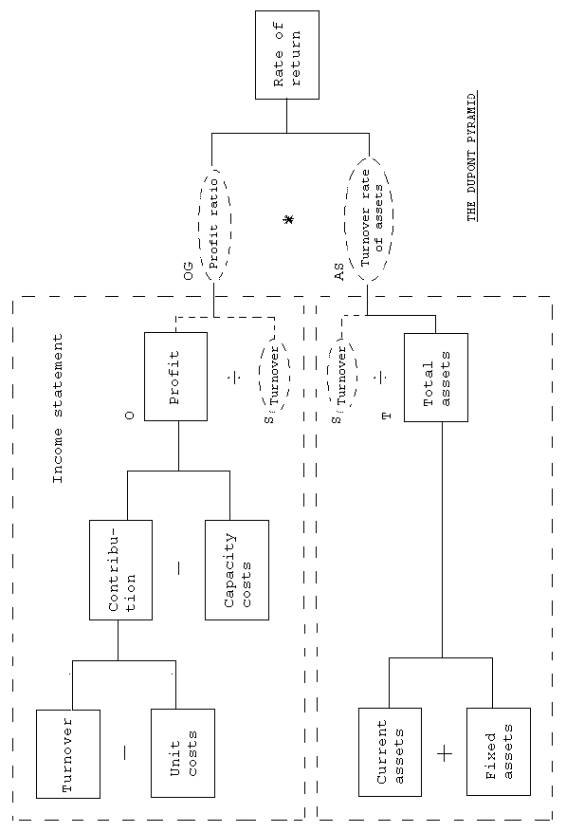
Figure 13.1
The Dupont Pyramid
.
- 68 -
13.2.1.
Ratio mathematics, general
For the ratio U given by equation (282):
y
U
= ¾¾¾ (282)
x
where y and x are system variable and/or
system state functions, finan- cial or physical, the general function given
by equation (283) applies in the same system:
y x1 xn xn+1
U
= ¾¾¾ ( ¾¾¾ - - - - ¾¾¾ ) ¾¾¾ (283)
x1 x2 xn+1 x
In equation (283) xi for i = 1, - - - -, n is an
arbitrary quantity of system variable and/or system state functions.
If we define the ratio G1 = y/x1, Gi = xi/xi+1 for i = 1, - - - , n and Gn = xn+1/x, equation (283) may be
given the equivalent form:
U = G1 G2 G3 - - - - Gn
(284)
This is exactly the ratio technique
forming the basis of the computati- on of the rate of return by the methods
described in Section 13.2. (By the inserted variable S in equation (280) or
by the product method in equation (281)).
A look at Bela Gold's work on managerial
ratios will show that equati- ons (282), (283) and (284) constitute the
theoretical contents of Bela Gold's application of ratios. It will be seen
.
- 69 -
that exactly the assumptions underlying
equation (283) are the reason why the equation is not unique for a given
system as regards the effect of the individual ratios on U. Thus, these
effects can only provide cer- tain indications as to states in the system
under study.
As a result of the above comments on the
lack of uniqueness of a number of factors in a given development of a
ratio, S, OG and AS are encircled by a broken line in Fig. 13.1.
The above equations provide the
theoretical background of the uncertain- ty found in the literature on
depiction of the Dupont pyramid. Thus, this pyramid is often shown without
the S, OG and AS areas encircled by broken lines. The Dupont pyramid has a
very simple memo-technical struc- ture. This structure consists of
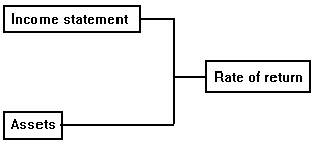
The Dupont pyramid is a kind of rough aid
for analysis purposes rather than a basic scientific figure with fundamental
contents, cf. above.
.
- 70 -
Conclusion
The literature on the whole area of
management, accountancy, manageri-
al economics and ratios has been
reviewed. Only one source, lit. 30,
has been found suitable for a more detailed
analysis in relation to
the management subject discussed:
Managerial ratios.
As shown in Chapter A, S. Eilon's work
takes as its starting point the
rate of return and defines a set of
equations which under different
circumstances describe the effect of the
rate of return. The assumpti-
ons underlying S. Eilon's equations are
considered more closely, and
two weaknesses are found in the
application of these equations. Eilon
uses the concept average variable costs,
which is a generally applied
concept in tradi tional managerial economics. Eilon uses also an empi- rically
based equation for the relationships between the sales activity and the
funds tied up in the operating system. These two assumptions have given
rise to the need for a continued theoretical development of the described
mathematical functions as well as graphical models.
In Chapter B a graphical analytical
business model is developed for
the purpose of giving management a
picture of fundamental characteri-
stics in the business within bookkeeping,
accountancy, managerial eco-
nomics and taxation. In Chapter B the
mathematical functional expres-
sion for inventory depreciation is
developed, equation (149), to form
the basis of the presentation of the
relationship between O'DS, B'ln and O' in Fig. 2.1.
On the basis of the general graphical
model with related mathematical
functions the mathematical analytical
model is developed in Chapter C.
This model includes a number of
definitions of general mathematical
functions as well as related parameters
so that the developed functio- nal expressions give an analytical
mathematical description of general-
.
- 71 -
concepts relating to book keeping,
accountancy, managerial economics and taxation in the business on the basis
of common input parameters, inclu- ding time as an explicit parameter.
Among the new functional expressions
developed in Chapter C special
attention is called to the definition
equation (174) together with the
condition equation (259) both of which
form the basis of the develop-
ment of the general expression for cash
flow released, see equation
(270). For assessments of the soundness
of cash flow released, two ra-
tios have been developed, interest
relative and depreciation relative,
see equati6n (271) and equation (272).
On the basis of the developed
mathematical functions the traditional
ratios are presented in an analytical
mathematical form as a function
of, among other things, time. To
facilitate analysis, the complex func- tional expressions found have not
been included in Chapter C, Section 13.
The Dupont pyramid, which forms the basis
of the so-called "rate-of-
return philosophy", is in Fig. 13.1.
divided into its basic components: Income Statement and Assets. The
elements encircled by broken lines in Fig. 13.1., which are often omitted
in representations, include the profit ratio and the turnover rate of
assets. The development of the general ratio formula given by equation
(283) has proved that the profit ratio and the turnover rate of assets are
arbitrary accounting ratios.
With equation (283) and equation (284)
the mathematical basis of the
computation of the rate of return and of
Bela Gold's empirically deve-
loped ratio technique, lit. 40, has been
developed.
.
- 72 -
BIBLIOGRAPHY
1. Ahlmark,
Dan:
Produkt - investering - finansiering
Stockholm 1974
2. Andersen, A. Geel:
Investeringsteori. Partiel
investeringsplanlægning under
sikkerhed
Copenhagen, The School
of Economics and Business
Administration 1973
3. Ansoff,
H. Iqor:
Strategisk planlægning
Copenhagen 1972
4. Arvidson,
Herbert:
Foeretagsvaerdering, 3.
Stockholm
1978
5. Arwidz,
Olof & Allan T. Maim:
Planeringssystem - en ram foer analys och konstruktion
Lund
1973
6. Asztely
Sandor:
Investeringsplanering
Stockholm 1973
7. Bacharach,
Michael:
Economics and the theory of games
London 1976
8. Baglini,
Norman A:
Risk management in international corporations
New York 1971
9. Baker,
A.J.:
Investment, valuation and the managerial theory of firm
Famborough 1978
10. Bannoch,
Graham:
Smaller business in Britain and Germany
London 1976
11. Bergienut,
P. och M. Hentzel:
Investering
Stockholm 1976
.
- 73 -
12. Bjarke,
Ø. and 0.1. Franksen:
System structures in engineering. Economic design and
production
Lyngby The Technical University of Denmark, AMT 1978
13. Børsen
PP3:
Erhvervenes og det offentliges udviklingsmønster fren
til
1982.
Copenhagen 1977
14. Coates,
C. Robert:
Investment strategy
London 1978
15. Coyle,
R.G.:
Management system dynamics
London 1977
16. Cleland,
David I. & William R. King:
Management. A system approach
New York 1972
17. Correa,
Hector:
Integrated economic accounting Lexington,
Mass. 1977
18. Danielsson, Albert:
Foeretagsekonomi.
Begreppsbildning och terminologie
Stockholm 1976
19. Danielsson, Albert:
Foeretagsekonomi - en oeversikt
Lund 1975
20. Danielsson,
Albert:
On measurement and analysis of standard costs
Stockholm 1963
21. Dansk
Management Center:
Inflationsregnskaber
Copenhagen 1978
22. Danø,
Sven:
Introduktion til levetidsproblemer i investeringplanlægningen
Copenhagen 1978
23. Dam-Jensen, Erik m.fl.
Regnskab og økonomi
Copenhagen 1977
.
- 74 -
24.
Donaldson, Gordon:
Strategy for financial mobility
Boston 1969
25.
Donaldson, Peter & Jim Clifford:
Economy and decision making
London 1977
26.
Dullum, K:
Virksomhedens økonomiske styring 1 & 2
Copenhagen 1975
27. Eckholm, Bo-Goeran:
Planering foer finansiell
handlingsberedskap
Helsingfors 1977
28.
EDB-rådet:
EDB, ledelse og økonomi
Copenhagen
1977
29. Eilon
S. and Phocas-Cosmetatos G:
Analysis of profitability components. Proc. Euro II, Second
European Congress on Operations Research pp
143-147 ...... 1976
30.
Eilon, Samuel & Cosmetatos, G.P.:
A profitability model for
tactical planning
OMEGA, Vol. 5, No. 6 1977
31.
Eilon, S., Gold Bela, and Soesan J.:
Applied productivity analysis for industry Pergamon Press,
Oxford 1976
32.
Eliasson, Gunnar:
Business economic planning
Stockholm 1976
33.
Fabryky, W.J. and G.J. Thuesen:
Economic decision analysis
Copenhagen 1974
34. Falster,
P.:
Graph-oriented production models in APL Lyngby,
The Technical University of Denmark, 1977
35.
Fiehn, Peter:
Produktionsstyring
Lyngby, The Technical University of Denmark, AMT 1978
.
- 75 -
36.
Fog,Bjarke:
Mikroøkonomi
Copenhagen 1977
37.
Forrester, Jay W.:
Industrial
Dynamics
Cambridge, Mass. 1977
38.
Gitman, Lawrence J.:
Principles of managerial finance
New York l976
39.
Gold, Bela:
Explorations in managerial economics
London 1971
40.
Gold, Bela:
Technological change. Economics, management and environment
Oxford 1975
41.
Grant, Alexander Thomas Kingdom:
Economic uncertainty and financial structure
42. Greene, Mark R.:
Decision analysis for risk management
New York 1977
43.
Grubbstroem, Robert W.:
Besluts- och spelteori med tillaempninger
Lund 1977
44. Gunst, Jens & Niels Lauritsen;
Planlaegning og prioritering
Copenhagen 1977
45. Hailes,
William D. & Raymond T. Hubbard:
Small business management New York 1977
46. Hansen,
Erik m.fl.:
Langtidsstyring
Copenhagen 1974
47.
Hartley, W.C.F.:
Likviditetsstyringens ABZ
Institut for lederskab og 1ønsomhed
Copenhagen
1978
48.
Hemming, Torn;
Multiobjective decision making under certainty
Stockholm 1978
.
- 76 -
49.
Industrirådet:
Industriens Økonomi
Copenhagen 1977
50.
Industriens Utredningsinstitut;
IUI's långtidsbedoemning 1976
Stockholm 1977
51.
Jacobsen, Vagn Thorsgaard:
Valg af strategi og beslutning under usikkerhed
Copenhagen 1971
52. Jensen, A.:
Planlægning i uvished
Lyngby, The Technical University of Denmark,
IMSOR 1977
53.
Jørgensen, Kj. Arnth:
Strategisk ledelse i mellemstore virksomheder
Danmarks Erhvervsfond 1977
54. Jørgensen,
Niels Lihn:
Dynamisk
input - output teori
Copenhagen 1977
55. Kallio, Markku:
Corporate planning model
Helsinki 1977
56. Keeney,
Ralph L. & Howard Raiffa:
Decisions with multiple objectives
New York 1976
57. Keloharjn,
Raimo:
Corporate modelling in system
dynamics
Helsinki 1977
58. Kenessey,
Zoltan:
Process
of economic planning
New York 1978
59.
Kline,John B.:
Management audit for small manufacturers
Wash. D.C. 1977
60. Kohn, Mervin:
Dynamic managing. Principles, process, practice
California 1977
.
- 77 -
61.
Levy, Ham & Marshall
Sarnst:
Capital investment and financial decisions
Englewood Cliffs. N.J. 1978
62. Lichtenberg,
S.:
Projektplanlægning
Lyngby, The Technical University of Denmark 1978
63.
Lin, Steven:
Conference on externalities, 1974. Southern Illinois
University. Theory and measurement of economic externalities.
New York 1976
64. Liung,
Birger:
Investeringsbedoeinning
Stockholm 1978
65.
Linestone, Harold A. & Devendra Sahal:
Technological substitution: Forecasting techniques and
applications
New York 1976
66. Longenecher,
Justin G.:
Essentials of management
Illinois 1977
67.
Lorange, Peter and others:
Strategic planning systems
Englewood Cliffs. N.J. 1977
68. MacKinzie, R. Alec..
New time management methods for you and
your staff
London 1975
69. Martel,
Jean Marc:
Adaptive strategies for a replacement problem
Louvain Univ. 1975
70. McLean,
Ephraim R. & John V. Soden:
Strategic planning for MIS
New York 1977
71.
Monks, Joseph G.:
Operations management. Theory and problems
New York 1977
72.
Muhlemann, A.P. m.fl.
On portfolio modelling in multiple criteria situations
under uncertainty
Manchester 1977
.
- 78 -
73.
Mulvaney,J.E. & C.W. Mann:
Practical business models
London 1978
74.
Neergaard, Peter:
På basis af - - - - -
Thesis
for the licentiate, The Copenhagen School of
Economics and Business Administration 1977
75.
O'Connor, Rochelle:
Planning under uncertainty
New York 1978
76.
Olsen, M. Kolbe:
Salgets planlægning og organisation
Copenhagen 1977
77. Papps, Ivy & Willie Henderson:
Models and economic theory
London 1977
78.
Parker, J.E.S.:
Economics of innovation
London 1978
79. Petersen,
Anders:
Konstruktion af systemer for økonomisk styrinq
Jern- og Metalindustriens Sammenslutning
Copenhagen 1976
80. Petersen, Eskild:
Målsætning i virksomheden
Copenhagen 1977
81. Peterson, Rein & Edward, A. Silver:
Decision Systems for inventory management
and production
planning
New York 1978
82. Pfeffer,
Irving:
Insurance and economic
theory Illinois 1956
83. Pitchford,
John D. & Stephen, J. Turnovsky:
Applications of control theory to economic analysis
Amsterdam 1977
84. Ramstroem, Dick:
Docentur I foeretagsekonomi
Uppsala 1977
.
- 79 -
85.
Riis, Jens Ove:
Design
of management Systems
Copenhagen 1978
86. Rasmussen,Flemming:
Eksempler på partiel
investeringsplanlaegning
Copenhagen 1977
87. Rasmussen, Flemming:
Partiel investeringsplanlaegning
Lyngby, The Technical university of Denmark, IMSOR 1978
88.
Rasmussen, G.:
Produktionsfunktioners anvendelse pA virksomhedsniveau
Lyngby,
The Technical university of Denmark, AMT .....
89.
Sandberg, Åke m.fl.:
Ny foeretagsekonomi
Stockholm 1978
90.
Samuels, J.M. and Wilkes, F.M.:
Management of company finance
London 1975
91. Simon,
Herbert A.:
New science of management decision
Englewood Cliffs., N.J. 1977
92. Siegwart, Hans:
Produktentwicklung in der
industriellen Unternehmunq
Bern 1974
93. Sofka, Michael:
Marketingstrategie fuer ein neues
Produkt
Diessenhofen 1971
94. Stemp, Isay:
Corporate
growth strategies
New York 1970
95. Steuch,
Axel:
Finansiel planlægning
Copenhagen 1977
96. Stone, Merlin:
Product planning
New York 1976
.
- 80 -
97. Sørensen,
Finn C.:
Artikier om kreditvurdering og regnskabsanalyse
Copenhagen 1978
98. Siegel, Paul:
Strategic planning of management
information systems
New York 1975
99. Steers,
Richard M.:
Organizational effectiveness
California 1977
100. Struntz, Harald:
Langfristige Personalplanung auf
der Grundlage von
Investitionsmodellen
Wiesbaden 1976
101. Sveriges Mekanfoerbund:
Nyckeltal i produktionen
Stockholm 1978
102. Sveriges
Mekanfoerbund:
Produktivitetsmaetning
Stockholm 1978
103.
Tamari, M.:
Financial ratios
London 1978
104.
Thage, Bent & Jørn Holdt:
Input
- output prismodel for Danmark
Copenhagen 1976
105.
Twiss, Brian C.:
Managing technological innovation
London 1976
106.
Wagner, Harvey M.:
Principles of operations research with applications to
managerial decisions
Prentice-Hall. Inc 1975
107.
White, D.J.:
Fundamentals of decision theory
New York 1976
108.
Williams, C. Arthur & Richards M. Hems:
Risk management and insurance
New York 1976
.
- 81 -
109.
Wong, Kenneth Kin:
Risk analysis and control. A guide for DP managers
Manchester 1977
110. Worre, Zakken:
Vejledning i driftsbudgettering i den
mindre virksomhed
Copenhagen 1974
111. Worre, Zakken:
Vejledning i likviditetsbudgettering i
den
mindre virksomhed I og II
Copenhagen
1973
112.
Young, Jerrald F.:
Decision making for small business in management
New York 1977
|